
For many permanent residents who first came to Canada as international students or temporary foreign workers, counting pre-permanent residence (pre-PR) time is the fastest route to Canadian citizenship. Because Immigration, Refugees and Citizenship Canada (IRCC) allows applicants to claim up to one full year (365 days) of credit from time spent in Canada as a temporary resident, newcomers can often apply after just two years as a permanent resident.
However, recent October 2026 discussions across Reddit's r/ImmigrationCanada community and Chinese-Canadian immigration forums highlight a frustrating setback: applicants waiting months for their Acknowledgement of Receipt (AOR) are instead having their applications returned as incomplete with the message: "We cannot confirm your physical presence before PR."
Understanding the exact statutory rules under the Citizenship Act and how IRCC validates temporary status records can help you prevent months of lost waiting time.
Key takeaways
- The minimum physical presence requirement is generally 1,095 days within the five-year eligibility window.
- Eligible pre-PR presence counts as half a day per day, up to 365 days of credit.
- Compare every pre-PR period with your actual immigration status documents, and exclude any period you cannot substantiate.
- Community reports illustrate potential problems; they are not a substitute for an official determination on your own file.
1. The Official Rule: How the 1,095-Day Calculation Actually Works
Under Section 5(1)(c)(i) and Section 5(1.001) of the Citizenship Act and IRCC's official eligibility guidelines, adult permanent residents applying for a grant of citizenship must meet strict physical presence criteria:
- The Rolling 5-Year Eligibility Window: Your eligibility period is the five years immediately before the date you sign your application, and you must meet the physical presence requirement the day before you sign (Form CIT 0407).
- The 1,095-Day Total and 730-Day PR Floor: You must have been physically present in Canada for at least 1,095 days during those five years, including a mandatory minimum of 730 days as a permanent resident.
- The 0.5-Day Temporary Resident Credit (365-Day Cap): Each day spent physically in Canada as an authorized temporary resident (visitor, student, worker, or Temporary Resident Permit holder) or protected person within the five-year window before becoming a PR counts as 0.5 days, up to a maximum credit of 365 days (730 calendar days).
Crucially, Form CIT 0407 specifies that work or study permits issued while a refugee claim or Pre-Removal Risk Assessment (PRRA) is still being assessed do not grant temporary resident status and cannot be counted.
Worked Example: Suppose an applicant spent 900 calendar days physically in Canada on valid study and post-graduation work permits before becoming a permanent resident. Although 900 days × 0.5 equals 450 days, the statutory cap limits pre-PR credit to 365 days. The applicant must still accumulate at least 730 full days physically in Canada after becoming a permanent resident to reach the 1,095-day minimum.
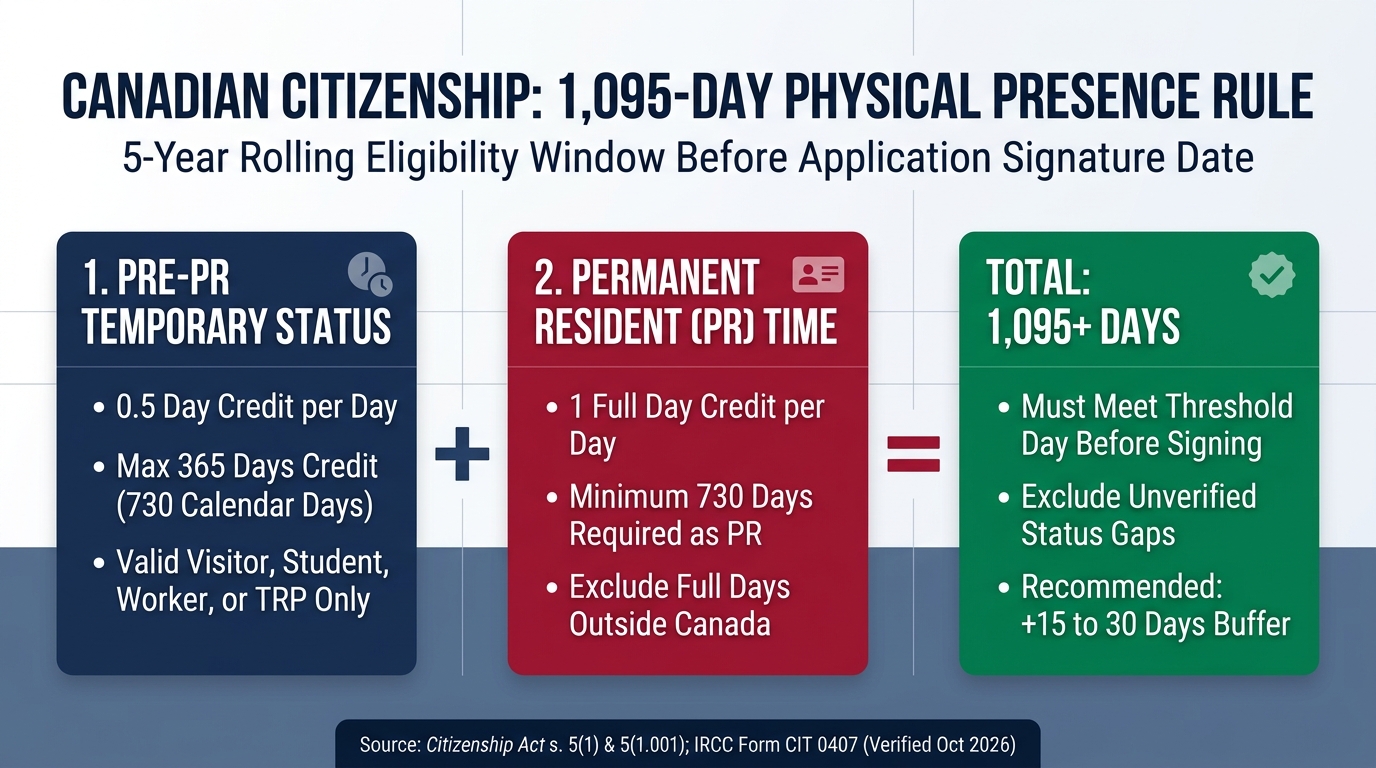
The 5-year rolling eligibility window and 1,095-day physical presence formula for Canadian citizenship. Sources: Citizenship Act, s. 5(1) & 5(1.001), IRCC Eligibility Rules, and IRCC Form CIT 0407 (Verified October 27, 2026).
2. Why IRCC Returns Applications Over Pre-PR Time
Based on verified official rules and recent applicant case reports, pre-PR verification returns typically stem from three errors in the Online Physical Presence Calculator:
- Misreporting "Maintained Status" During Study-to-PGWP Transitions: Under IRCC's maintained status rules, a temporary resident keeps legal status after a permit expires only if they applied to extend or change their status from inside Canada before the permit expired. In a widely discussed October 18, 2026 Reddit case, an applicant applied for a Post-Graduation Work Permit (PGWP) from outside Canada in July 2022, re-entered Canada on August 1, 2022, and remained in Canada after their study permit expired on August 31, 2022 until PGWP approval in November 2022. Because the PGWP application was submitted outside Canada, the applicant did not hold student maintained status during the autumn gap. Logging that period as "Student" triggered an immediate mismatch with IRCC's records and caused the citizenship application to be returned.
- Overlooking Status Gaps or Restoration Periods: Any days spent out of status in Canada—such as waiting for a Restoration of Status decision after a permit expired—do not count as authorized temporary residence. Contrary to a common forum myth, an expired study or work permit does not automatically convert into visitor status unless the person was formally admitted as a visitor at a port of entry (IRCC Help Centre Q1309) or applied for a visitor record before expiry.
- Applying With Zero Buffer Above 1,095 Days: When an applicant submits their file at 1,095 or 1,096 days, removing even a single unverified pre-PR status gap pushes the total below the statutory minimum.
3. Practical Solutions Before You Submit (or Resubmit)
If your application is returned as incomplete before AOR, it is not a formal refusal: no file number is created in GCMS and your full adult fee of $653.00 CAD ($530.00 processing fee plus the $123.00 Right of Citizenship fee, or $100.00 for a minor, per IRCC's Official Fee List) is refunded, but your five-year eligibility window shifts forward to your new signature date. To ensure your application passes intake smoothly:
- Follow IRCC's "When in Doubt, Leave It Out" Rule: Form CIT 0407 explicitly instructs applicants: "If you are unsure if you held authorized temporary resident or protected person status for any period before becoming a permanent resident, do NOT include that period in your physical presence calculation."
- Audit Every Permit Against Exact Dates: Match every pre-PR entry in your calculator to the exact issue and expiry dates printed on your historical study permits, work permits, visitor records, and eCOPR. Remember that when logging trips abroad, neither the day you left Canada nor the day you returned counts as a full day of absence (Form CIT 0407).
- Build a 15- to 30-Day Safety Buffer: Follow IRCC's official recommendation to apply with well over 1,095 days—or, if you are already close to your third anniversary as a permanent resident, wait until your post-PR days alone cover the 1,095-day requirement so disputed pre-PR transitions cannot derail your file.
- Know When (and When Not) to Order a CBSA Travel History Report: Despite frequent forum advice to attach a Canada Border Services Agency (CBSA) Travel History Report to your application, the CBSA Travel History Report Official Guide explicitly states that citizenship applicants do not need to request or submit this report for IRCC, as IRCC retrieves entry/exit data directly from CBSA and waiting up to 30 days for a report can delay your filing. Order a free CBSA report under the Privacy Act only if you need to double-check forgotten trip dates for your own calculation—not to cure an unverified temporary permit gap in IRCC's records.
Before you use this guide
This draft is adapted from the October 2026 Northora editorial package. Reconfirm fees, procedural details and status rules against current IRCC guidance before publication. Community experiences do not establish a standard processing timeline.
Sources
- Citizenship Act — Section 5 (Justice Laws) ↗
- IRCC — Who can apply for Canadian citizenship ↗
- IRCC — Calculate your physical presence ↗
- IRCC — CIT 0407 physical presence calculation guide (PDF) ↗
- IRCC Help Centre — Maintained status (Q188) ↗
- IRCC — Restore your status ↗
- IRCC — Citizenship application fees ↗
- CBSA — Travel History Report ↗
- Reddit — Applicant experience (not official) ↗
Independent editorial, not an official government service. Check official sources.
Reviewed:—